Victor
Bird BoxVictor is Jules’s six-year-old border collie, a companion who helps make the Shillingham house feel inhabited and who later becomes central to Malorie’s struggle to obtain equipment for the household. The survivors imagine dogs as guides and protectors in a world they must navigate without sight; Victor’s death exposes the limits of that hope, showing that animals, too, can be affected by the unseen danger.
Identity and Introduction
When Malorie first enters the living room, Victor trots over, regards her curiously, and waits at her feet for attention. Jules introduces him by name and says he got Victor as a puppy. Malorie pets him and thinks Shannon would have liked him. This brief welcome places Victor among the household’s ordinary comforts: he is not merely an alarm or a tool, but a familiar animal with a history and a place in the home.
His presence is woven into the house’s routines and guarded rooms. The windows are covered, and the cellar and attic are discussed as possible places of refuge if one of the creatures gets inside. In this closed environment, Victor’s ability to move about and respond to sounds makes him especially noticeable to the people who cannot look freely beyond their coverings.
A Household Companion and Possible Guide
Victor’s significance first emerges through the household’s dependence on careful procedures. When Felix makes a blindfolded trip to the well, Jules waits outside and Cheryl listens from behind the closed back door as a safety net. Victor belongs to this larger environment of watchfulness, in which ordinary tasks require routes, ropes, and someone prepared to respond if things go wrong.
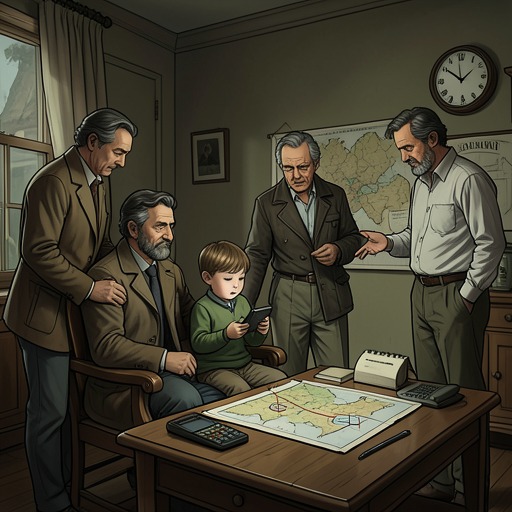
The group also considers a more active role for dogs. Tom proposes protective helmets, butcher knives, and dogs that could lead the blindfolded expedition; if an animal went mad, the plan was to release its leash and defend against it. Don challenges the premise by pointing out that the proposed journey would be undertaken blind. The plan shows that the survivors see dogs as potential guides, but it also acknowledges that an animal might become a danger rather than an aid.
Later, while Tom and Jules are away, Victor sits behind an easy chair facing the blankets over the windows. Malorie imagines that he is waiting, as she is, for his master to return. His orientation toward the covered windows turns the house’s uncertainty into a repeated domestic image: people and dog alike wait for news from beyond the barriers, unable to see what is happening outside.
Malorie’s Journey with Victor
After giving birth, Malorie decides to drive blindfolded to find a microphone. She takes Victor with her, despite Jules’s earlier refusal to let him be used in that way. The circumstances have changed: she has newborns to care for, her body has not recovered, and she needs equipment that could help protect or support the household. She paints the windshield black and covers the glass and bumpers with materials taken from the house and garage, attempting to make the journey possible without exposing herself to direct sight.
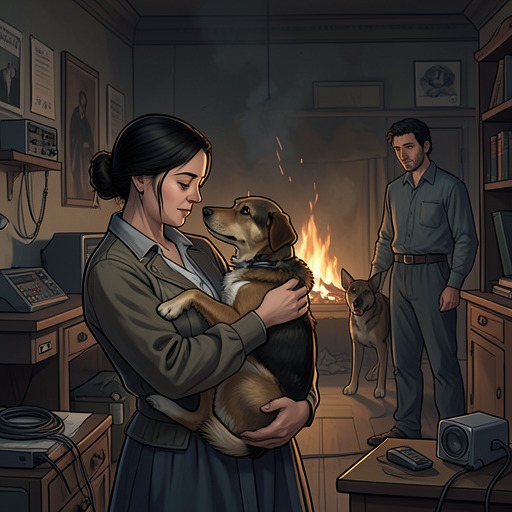
The search takes repeated attempts. Malorie finds a laundromat on her seventh try, then enters several other businesses, including a boot store, a coffee shop, an ice-cream parlor, and a theater, without finding the bar. On the ninth afternoon, she enters an unlocked wooden door and recognizes that she has reached her destination. Victor has accompanied her through this difficult search; once inside, she kneels and embraces him around the neck, relieved that they have found the place.
That relief does not last. Victor moves toward a room that Malorie associates with death, and she pulls him away and ties his leash to a wooden post while trying to calm him. He emits a growl she has never heard from him, then moves so violently that the post splinters. Malorie is still searching for the microphone, and when she reaches the stage and finds it, Victor is being fatally injured. She has achieved the immediate objective of the trip, but at the cost of the companion she brought to help her.
Death and Consequences
The loss follows Malorie back to the newborns. She returns with two small amplifiers and the microphones, then lies awake, remembering Victor’s sounds and grieving. Her conclusion is stark: dogs are not immune and can go mad. This knowledge revises the household’s expectations of animal assistance. A dog might guide the blindfolded, but its presence cannot guarantee safety, and it may itself become vulnerable to the same crisis that threatens people.
Victor’s death also carries a personal cost beyond the practical failure of the plan. Malorie thinks of Jules, who loved Victor deeply, and understands that the dog was her last link to the housemates. His loss connects the distant household she has left behind with the immediate danger of the journey: the dog is at once a companion, a possible means of survival, and the bond through which Malorie feels the separation from Jules.
Narrative Significance
Victor’s role complicates the survivors’ effort to turn animals into instruments of survival. Tom’s proposal treats dogs as guides that might be released or killed if they become dangerous; Malorie’s journey instead makes the consequences intimate and irreversible. Victor is not an abstract resource but Jules’s longtime companion, welcomed by Malorie and trusted to protect the newborns. His death answers that trust with a painful limit: affection cannot make an animal immune, and usefulness cannot protect it from the disaster.
The novel also places Victor among other animals whose behavior gives people partial, uncertain knowledge of the unseen threat. A broken bird in Malorie’s hand reveals that birds are fighting above her, while Victor’s death makes clear that dogs can also be affected. Neither animal observation offers mastery over the danger. Victor’s story turns the household’s hope for guidance into a warning, and his absence remains bound to Malorie’s memory of Jules and the home she has left.